
Kaufman Projected Versus Actual Release
TDCJ defines Projected Release Date as the date its Classification and Records Office calculates for leaving incarceration if parole does not occur first. It is a forecast tied to the sentence and current credits. It is not parole eligibility, a Board vote, maximum sentence date, actual release, or discharge. Discharge means the correctional obligation has ended. Actual release records when physical custody changed.
A pretrial detainee at the Kaufman County Detention Center has no computed sentence-release date. The stay can end through bond, a judge's order, dismissal, transfer, or another event. A person serving a county sentence requires the written judgment, sentence start, jail credit, and sheriff calculation. Texas provides no single county-and-state release calculator that can reliably merge those paths.
Find Kaufman Projected Release Dates
Start with the agency that holds the person. A Kaufman County jail booking and a TDCJ sentence are not interchangeable. Removal from the county current roster may mean community release, but it may also mean transfer to TDCJ, another county, or a federal or immigration authority.
- For a state prisoner, open the TDCJ Online Inmate Search. Prefer a seven-digit TDCJ number or SID; otherwise use name and narrowing fields.
- Compare identity, conviction county, offense, sentence, status, and location before relying on the detail record.
- Read Projected Release Date beside parole eligibility and maximum sentence date. Do not merge the labels.
- For a county sentence, obtain the signed judgment and jail-credit record, then call Kaufman Jail/Inmate Records at 972-932-4337 with the case or booking number.
- For a pending case, inspect the court docket for a bond, dismissal, sentence, or transfer order rather than calculating a date.
TDCJ also accepts an offender-information email at pia@tdcj.texas.gov. Include full name and TDCJ number. If the number is unknown, add exact birth date or approximate age and conviction county. That streamlined route can return a projected release date, but it does not provide photographs. The broader county search and release-record path appears on the Kaufman County home page.
The official TDCJ offender search is the source for the state-record fields described here.
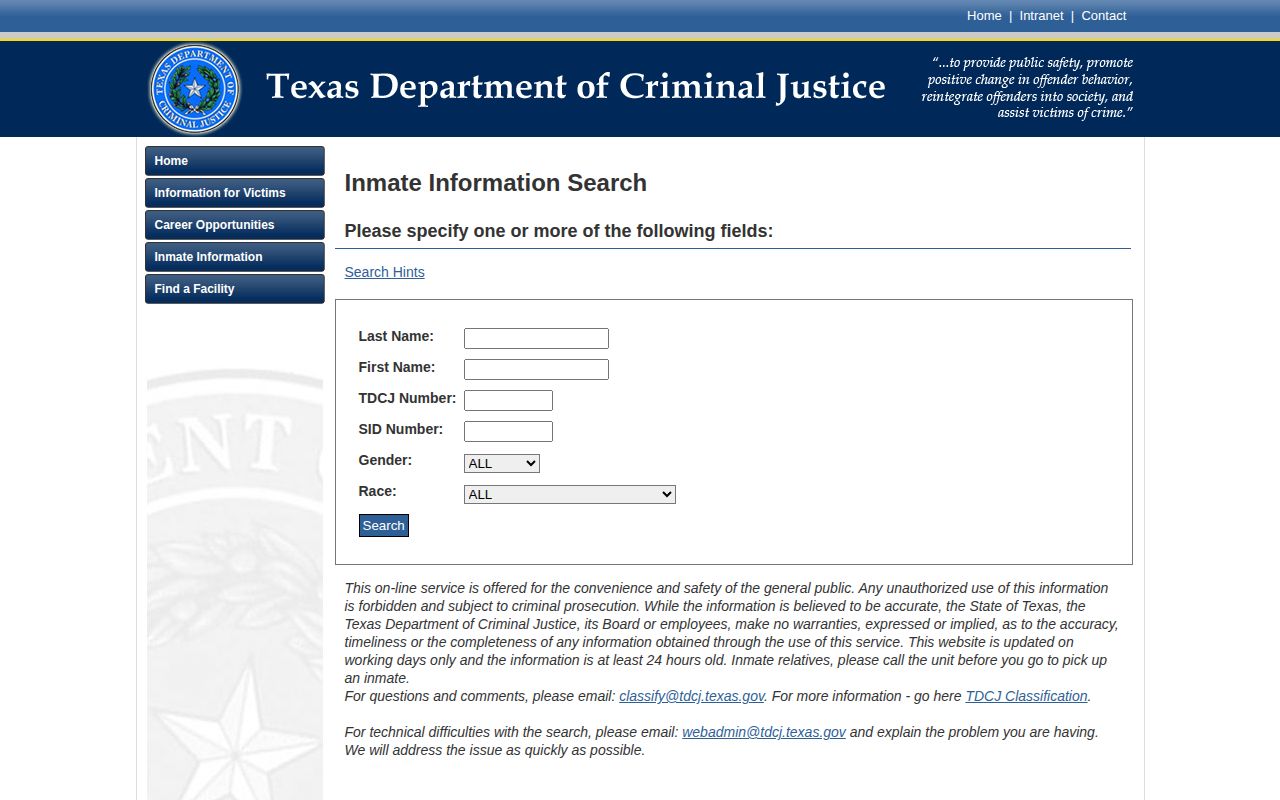
The search screen reinforces why a TDCJ or SID number is more precise than a name-only query and why the detail record must be opened.
Texas Good Time in Kaufman Cases
Texas Government Code Chapter 498 controls the core good-conduct-time rules. Section 498.003 says good time applies to eligibility for parole or mandatory supervision and does not otherwise reduce the length of the sentence. Section 498.004 addresses forfeiture and permitted restoration. That is why adding credit to calendar time is not a safe way to promise a release day.
Parole and mandatory-supervision rules appear in Government Code Chapter 508. Eligibility depends on the offense, offense date, sentence, enhancements, and findings. Some cases face calendar-time minimums or exclusion from mandatory supervision. For eligible later offenses, mandatory supervision can require Board approval even when the arithmetic point is reached.
Maximum expiration marks the sentence term's end under the controlling calculation. Parole eligibility is only the first point at which review may occur. Neither is the same as discharge. Use the current TDCJ record and the signed judgment instead of a general percentage rule.
Why Kaufman Release Dates Change
A displayed date reflects the record known at that point. TDCJ may revise it when sentence data, credit, Board action, or release processing changes. The reason matters because some changes alter the legal calculation while others delay physical release after favorable action.
| Change | Possible effect |
|---|---|
| Sentence or jail-credit correction | Moves the controlling calculation when a court or records office corrects time. |
| Concurrent or consecutive cases | Changes how several sentences run together or one after another. |
| Good-time forfeiture or restoration | Changes eligibility credit under applicable TDCJ rules. |
| New hold, detainer, or sentence | May prevent community release or cause transfer to another authority. |
| Board action | Approval, denial, or later mandatory-supervision review can alter the path. |
| Program or release-plan work | A favorable vote may still require a program, residence approval, or special-condition processing. |
| Later court order or data correction | Can replace facts used in the prior display. |
A favorable Board code is not a door-out timestamp. TDCJ Review and Release Processing checks required programs, release plans, county-of-residence rules, discipline, and conditions. If a favorable vote appears while custody continues, that office can explain pending processing.
Confirm Kaufman Actual Release
For a Kaufman jail episode, ask Jail/Inmate Records for the date and time, release type, authority or order, and destination or receiving agency. The official released-mode grid is useful as a lead but omits the exact release timestamp, reason, destination, and photograph. A transfer entry means county custody ended, not that all custody ended.
For a TDCJ case, read status and location with the date fields. An on-supervision status or parole-office assignment supports release from prison, while discharged indicates the correctional obligation ended. Texas now uses IVSS-Counties for county custody alerts. Enrollment can help track an event, but an alert can lag and is not the final legal record. Instructions are on the VINELink Inmate Search page.
No Kaufman 85 Percent Rule
Texas has no blanket rule that every prisoner serves eighty-five percent of a sentence. The result depends on the offense and date, the judgment, sentence structure, statutory exclusions, good-time status, and Board action. A broad percentage can therefore point to a day that has no legal force in the individual record.
For an eligible offense before September 1, 1996, the projection generally reflects when calendar time plus credited good time reaches the sentence, absent earlier parole. For eligible later offenses, mandatory supervision is discretionary and Board review matters. If mandatory supervision is excluded, the projected date ordinarily tracks maximum expiration based on flat time unless parole occurs first. TDCJ's official definitions should sit beside any date interpretation.
This offense-and-date framework is the reason a calculator cannot replace the TDCJ Classification and Records calculation. Obtain the judgment and use the labels shown for that person. If the dates appear inconsistent, request a calculation explanation rather than choosing the most favorable field.
A Kaufman conviction can generate several records that answer separate questions. The judgment fixes the sentence and court-awarded credit. TDCJ Classification and Records applies state calculation rules. The Board decides parole and discretionary mandatory-supervision matters. Review and Release Processing handles the plan and conditions that can remain after a favorable vote. The final release or transfer transaction records what actually occurred.
Keep a dated copy of the offender detail when timing matters. Later changes can be legitimate rather than an error, especially after a new order, data correction, disciplinary action, or Board decision. Compare the new display with the judgment and prior record. Then ask the agency which input changed. That method is safer than treating an old screenshot as a promise.
If the Kaufman County jail reports transfer to TDCJ, allow time for intake and indexing before assuming that a missing state result disproves the transfer. Use the booking number, case number, TDCJ number, or SID to connect the records. A transfer ends the county-jail episode but begins or continues a different custody record.
Kaufman Release Date Label Check
Several dates can appear in one TDCJ detail record because each answers a distinct question. Parole eligibility marks when review may begin under the controlling law. A projected release date is the current calculated prison-exit estimate if parole does not happen sooner. Maximum sentence date reflects the sentence endpoint under the applicable calculation. A review date concerns Board consideration, while an actual release date records an event that occurred. Discharge goes further and marks the end of the correctional obligation.
Read status and location at the same time. A parole-office assignment or on-supervision wording can show that the person left prison but remains under TDCJ oversight. A unit location points to continuing prison custody. A favorable vote code can identify a Board decision while a required program or release plan still delays physical departure. None of those entries should be converted into an exact pickup time.
County records use a different frame. The Kaufman sheriff release transaction should state when its custody ended and may identify the release type or receiving authority. The court order supplies the legal basis. If the destination is another jail, TDCJ, ICE, or a federal authority, follow that agency's locator after allowing for data entry. The next record may not appear at once.
Keep the search date with every saved result. If family or counsel receives conflicting dates, compare the newest TDCJ detail, signed judgment, jail-credit entry, and any later court order. Then ask the office responsible for the calculation to explain the difference. This creates a record-based answer without treating a public display as an unchangeable promise.