
Kaufman County's Three-Day Release Window
The official jail application supports a released mode with a number-of-days field. Entering 3 makes a 72-hour-style query. The agency does not publish a distinct URL labeled as a 72-hour list, and it does not define whether three days means rolling hours or calendar-day groups. The accurate description is the application's three-day released filter.
That wider setting helps with catch-up work. It can find events that have fallen outside a one-day query by Monday or after an office closure. It also supplies more possible matches, so compare name, descriptive fields, admit date, charge, court type, and arresting agency.
Check Kaufman County Three-Day Releases
Begin in released mode. The current roster has a similar days control but answers whether a person remains booked. A direct released-route request can redirect, so begin with a normal session at the application landing page.
- Open the sheriff jail application and navigate to released search.
- Choose the days option, enter 3, and submit.
- Review relevant result pages and compare identity fields.
- Record the search time and useful booking details.
- Call Jail/Inmate Records at 972-932-4337 for time, reason, and destination.
Use the Kaufman County one-day release view for today's activity. The three-day setting is broader, not more current.
Kaufman 72-Hour Release Fields
The three-day query returns the same grid as the one-day setting. A wider parameter does not add record fields. Some columns may be hidden on a narrow display.
| Grid field | How to read it |
|---|---|
| Full name | Starting identity field; confirm with other traits. |
| Age, race, sex | Helps separate similar names. |
| Admit date | Marks the start of jail custody, not release. |
| Court type | Helps route a case search. |
| Primary charge | Booking allegation, not final disposition. |
| Arresting agency | Agency tied to the arrest. |
Release time, code, bond outcome, receiving agency, destination, and photograph are absent. Ask for those facts instead of inferring them. A result can mean community exit, transfer to TDCJ, another jail, or an immigration authority.
The official Kaufman released grid appears in the successful research capture.
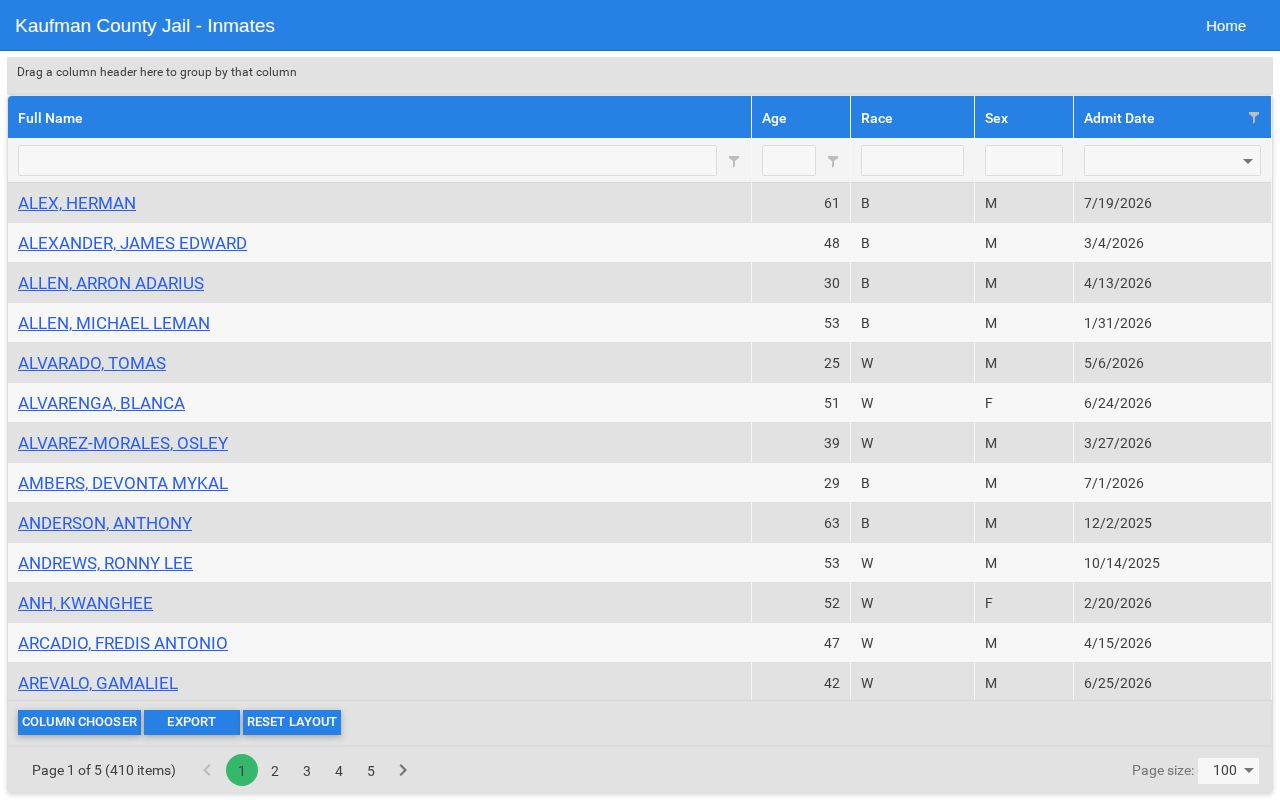
The sparse fields make direct follow-up essential.
Kaufman Weekend Release Catch-Up
Release processing can occur beyond the sheriff's administrative hours. No public source promises a fixed walk-out time or weekend posting. The three-day control is useful as a catch-up filter, not proof that every event from a formally defined weekend appears.
A court may authorize release before the interface changes. Staff may still verify the order, check holds, resolve property, or coordinate a receiving agency. Call the jail for an urgent status check. Pair the sheriff sheet with the court docket and signed order for a durable explanation.
Note: Search time and agency confirmation are more reliable than assuming the three-day result updates at midnight.
Kaufman Release Verification Fallbacks
If released mode fails, contact Jail/Inmate Records. The sheriff lists 1900 E US-175, Kaufman, TX 75142 and weekday business hours from 8:00 a.m. to 5:00 p.m. Processing itself is not limited to those hours. Supply full name, date of birth, admit date, and booking or SO number.
Use the open-records form to request the booking and release sheet, exact time, code, destination, receiving authority, and related order. State that the request concerns jail detention records.
Texas IVSS-Counties supports event notification. TDCJ serves a state-prison episode only. For one person across several systems, the Kaufman County released inmate lookup gives the custody-specific sequence.
Kaufman County Release Destinations
Released means Kaufman County ended physical custody. It does not say who received the person. Bond, dismissal, probation, time served, or another order can lead to community release. A prison commitment, outside warrant, federal action, or immigration hold can lead to transfer.
- Release sheet
- Sheriff record identifying time, code, and receiving authority.
- Court disposition
- Filed outcome explaining bond, dismissal, judgment, sentence, or probation.
- Receiving locator
- TDCJ, another sheriff, BOP, or ICE channel used after transfer.
Follow the authority named in the record. Absence from the live roster proves only that Kaufman County no longer reports current custody there.
Forney's Different 72-Hour Rule
Forney Police documents a maximum 72-hour detention in its municipal holding operation. That limit is not the same as selecting 3 in the sheriff's released grid. One describes how long Forney holds a prisoner. The other filters records already placed in Kaufman released mode.
A person can leave the Forney holding cells by local release or transfer to the Kaufman County Detention Center or another authority. Transfer is not community release. Ask Forney where custody went next, then use the sheriff record if the county accepted the booking.
This distinction prevents two local uses of “72 hours” from being treated as one rule. The time cap and the search parameter come from different agencies and events.
Kaufman Three-Day Release Data Limits
No sheriff page gives the grid a refresh cadence or retention guarantee. Multiple result pages and older admit dates were observed, but observation is not policy. Session redirects and hidden columns add uncertainty. Preserve identifiers, then obtain the transaction.
Local reporting derived from sheriff releases shows outcomes including bond, probation, TDCJ, immigration action, and holds. That breadth reinforces the need for a destination field. The three-day list is not a list of people who all walked free.
The grid's admit date can be much earlier than the selected three-day window because it describes when the jail episode began. It should not be treated as a release date or as proof that the query ignored the user's setting. Only the booking and release transaction can supply both endpoints of the episode. If the same name appears more than once, compare the episode identifiers and court cases before joining the records.
A failed name search can also reflect spelling, aliases, or the wrong custodial agency. Search the exact legal name and a reasonable partial form, then check the current roster to distinguish an ongoing Kaufman booking. If neither mode resolves the question, call records. Another county, TDCJ, BOP, and ICE each maintain different custody systems; none is automatically copied into Kaufman's three-day results.
Request Kaufman 72-Hour Release Details
A precise request should identify the person with full name, date of birth, booking or SO number, admit date, and case number when known. Ask for the actual release date and time, release type or code, a code legend, releasing facility, destination, receiving agency, bond details when applicable, and the order tied to the action. Request the booking photograph only when it is needed for identification and subject to lawful release.
The sheriff may provide a responsive record with lawful redactions or seek a Texas Attorney General ruling when it believes information is excepted. The court record follows a separate custodian path. County Clerk handles Class A and B misdemeanor files, while District Clerk handles felony district cases. That split is why a sheriff release sheet and a court judgment may need separate requests.
Public Record Search
Sponsored Results