
Understanding Kaufman County Releases
A Kaufman County release closes or changes one local jail episode. It does not decide guilt, erase a charge, or always return the person to the community. Bond, personal bond, dismissal, probation, time served, completion of a county term, or another court order may permit community release. The same sheriff reporting stream can also record a transfer to the Texas Department of Criminal Justice, another county, a federal authority, or immigration custody. The decisive question is specific: released to whom, when, and under what authority?
After local custody ends, the person normally drops from the sheriff's current-inmate view. The official application has a released mode, but its result is only a lead. The booking and release sheet gives the physical custody transaction. A court order explains the legal event. A receiving agency's locator may show where confinement continued. Read those records together before treating disappearance as community release.
Kaufman County Release Paths
The correct follow-up depends on the destination recorded by Kaufman County. A bond or time-served release usually calls for the sheriff transaction and court docket. A transfer requires a second custody search.
| Path | What it means | Next record |
|---|---|---|
| Bond or personal bond | Jail custody ends while the case may continue. | Release sheet and bond order |
| Time served or dismissal | A court action permits local custody to end. | Timestamp and signed docket entry |
| Probation | Community supervision follows judgment. | Judgment and Kaufman CSCD |
| TDCJ transfer | County custody ends, but state confinement begins. | Sheriff destination and TDCJ record |
| Other authority | Another county, USMS, or ICE may receive custody. | Named receiving agency |
Kaufman County Release Record Fields
The public released grid is not the complete Kaufman County release record. A focused request should connect one person to one confinement episode. Full name, date of birth, booking date, case number, and local or SO number help prevent a namesake error.
| Field | What it shows |
|---|---|
| Name, aliases, DOB, descriptors | Identity details used to distinguish similar names. |
| SO or booking number | Links arrest, charge, image, confinement, and release entries. |
| Booking date and arresting agency | When the episode began and who initiated it. |
| Charges, case numbers, bond | Why the person was held; charges remain allegations until disposition. |
| Release date and time | When Kaufman County ended physical custody. |
| Release type or code | Bond, time served, probation, order, transfer, or another outcome. |
| Destination | Community release or transfer to another authority. |
| Court reference | The order or docket action supporting release. |
| Booking photograph | The intake image, if public and responsive. |
Ask for a code legend when an abbreviation is unclear. Never infer a release reason from a charge label. Probation or parole can follow release even though confinement ended.
Request Kaufman County Release Records
Use the Kaufman County Sheriff Open Records Request when the grid lacks a field or no longer shows the person. Jail/Inmate Records is at 1900 E US-175, Kaufman, TX 75142, phone 972-932-4337, with mail to Drawer 849, Kaufman, Texas. Listed hours are Monday through Friday, 8:00 a.m. to 5:00 p.m. No sheriff copy-fee schedule was verified.
- Identify the person with full name, DOB, booking date, and SO or booking number.
- Ask for the booking and release sheet for a narrow confinement period.
- Request the actual date and time, code and legend, authority, destination, receiving agency, and photograph if needed.
- Select delivery and allow lawful redactions. Compare the response with the court docket.
The sheriff says an accepted redacted copy will be provided within ten working days. An unredacted request may be referred for an Attorney General ruling and can take up to 45 working days. Those statements are not universal completion guarantees. Incident-oriented form fields may not fit a jail release neatly, so name the detention center and state that detention records are requested.
Review the official sheriff form before drafting the description.
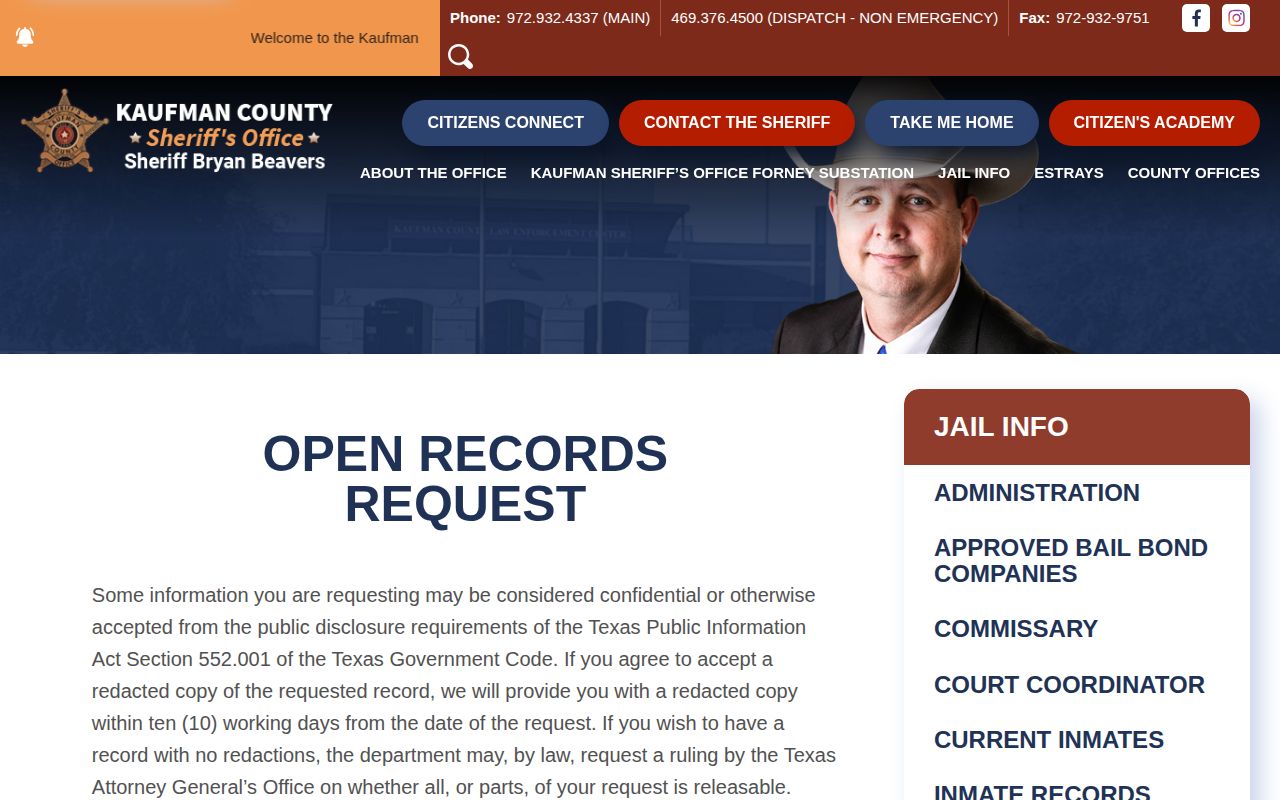
The form shows why a precise document description and known booking identifiers help the records unit locate the correct episode.
Kaufman County Release Record Law
Texas Government Code Chapter 552 governs public information requests. Send the request to the custodian that created or received the record. Sheriff detention files go to the sheriff, misdemeanors to the County Clerk, felony district files to the District Clerk, and state correctional files to TDCJ.
Government Code section 552.108 and other law may protect specified investigative or prosecutorial information. Juvenile, victim, medical, security, and expunged material can require redaction or withholding. Expunction under Code of Criminal Procedure Chapter 55A differs from nondisclosure under Government Code Chapter 411, Subchapter E-1. Eligibility depends on the disposition, not merely release.
Kaufman Bond Release Supervision
Kaufman County maintains a Pretrial Bond Supervision Department at 1906 E US Hwy 175. It assists judicial officers with release decisions and monitors people released on bond or diversion. Bond-out can end jail custody while the case and release conditions continue.
This status is neither parole nor sentence discharge. The sheriff supplies the door-out time. The order supplies conditions. Pretrial Bond Supervision can corroborate monitoring, while TDCJ and county adult probation serve different groups.
A person released on a personal bond can therefore appear in the sheriff's released results while remaining subject to court dates and monitoring terms. Look for the bond order in Odyssey, then match its case number to the booking episode. If the order names the pretrial office, that office can address supervision questions. It cannot replace the sheriff's timestamp or the clerk's certified copy.
Kaufman State Release Scale
TDCJ's FY2024 report counts 255 state-system releases by Kaufman county of conviction: 187 prison, 49 state jail, and 19 SAFP releases. This is scale context, not the number processed by Kaufman County Detention Center.
County of conviction does not prove where someone was physically released. Individual confirmation still requires the TDCJ status and date record. Nor does the annual total identify a particular release date, receiving address, parole office, or later discharge. Those facts remain person-specific.
The distinction also protects against double counting. A person can leave the Kaufman jail for TDCJ and later leave a state facility. Those are two separate custody events held by different agencies. The county release transaction documents the transfer out. TDCJ documents the later prison release or discharge.
Find Kaufman County Released Inmates
Begin with the custody episode. Someone bonded from Kaufman County jail may never appear in TDCJ. Someone transferred to TDCJ may vanish locally while still confined.
- Search the exact name in the sheriff current-inmate tool. A match reports present county custody; no match is not proof of release.
- Enter released mode and search by name or days. Save the result date and identifiers.
- Request the sheriff transaction for the timestamp, reason, code, destination, and receiving authority.
- Search the Kaufman court portal for the exact case and signed orders.
- Follow a named destination through TDCJ, another sheriff, ICE, or the federal system.
- Use TDCJ for a released state prisoner and BOP for a released federal prisoner.
Kaufman TDCJ Release Search
The TDCJ Online Inmate Search applies when Kaufman records name TDCJ or state prison. It covers TDCJ incarceration, parole, and mandatory supervision, not every county bond or time-served release.
Prefer the seven-digit TDCJ number or SID. Otherwise search last and first name, then narrow with sex or race. Compare identifiers, offense, sentence, and conviction county. Read current location with projected release, parole eligibility, maximum sentence, and actual release wording. Those dates are not interchangeable. “On supervision” means prison release with an active sentence; “discharged” indicates the correctional obligation ended.
Open the official offender search to use its identity fields.
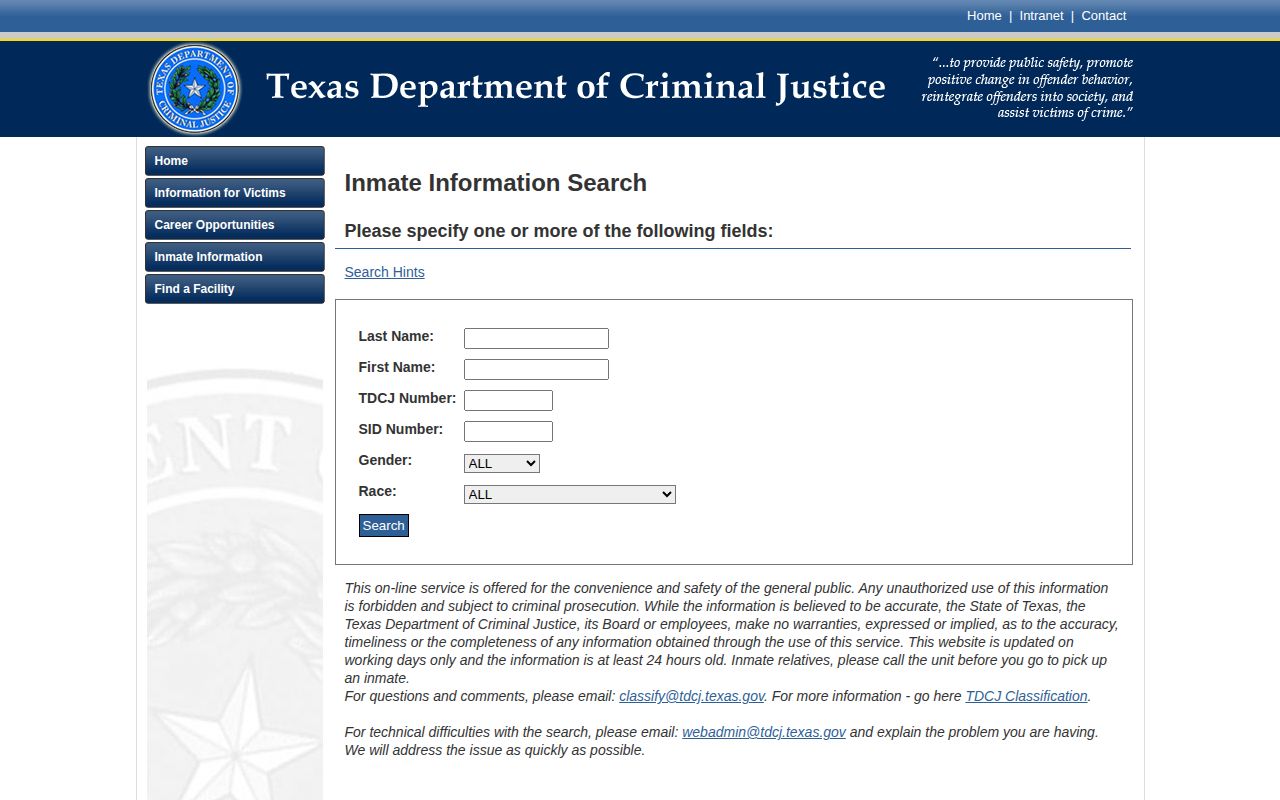
The interface supports exact identifiers and name filters that should be checked against the sheriff's recorded destination.
Kaufman County Released Mode
The sheriff application supports an official released-mode route. It accepts name, charge description, or a number of days. One day gives a 24-hour-style query and three days a 72-hour-style query. They are choices within one application, not stable separate feeds.
The released grid shows full name, age, race, sex, and admit date. Responsive columns include court type, charge, and arresting agency. It omits release time, reason, destination, receiving agency, and photograph. No cadence or retention guarantee was published. A stateless request may redirect, so begin a normal session at the landing page and then enter released mode.
View the official result grid as a search lead.
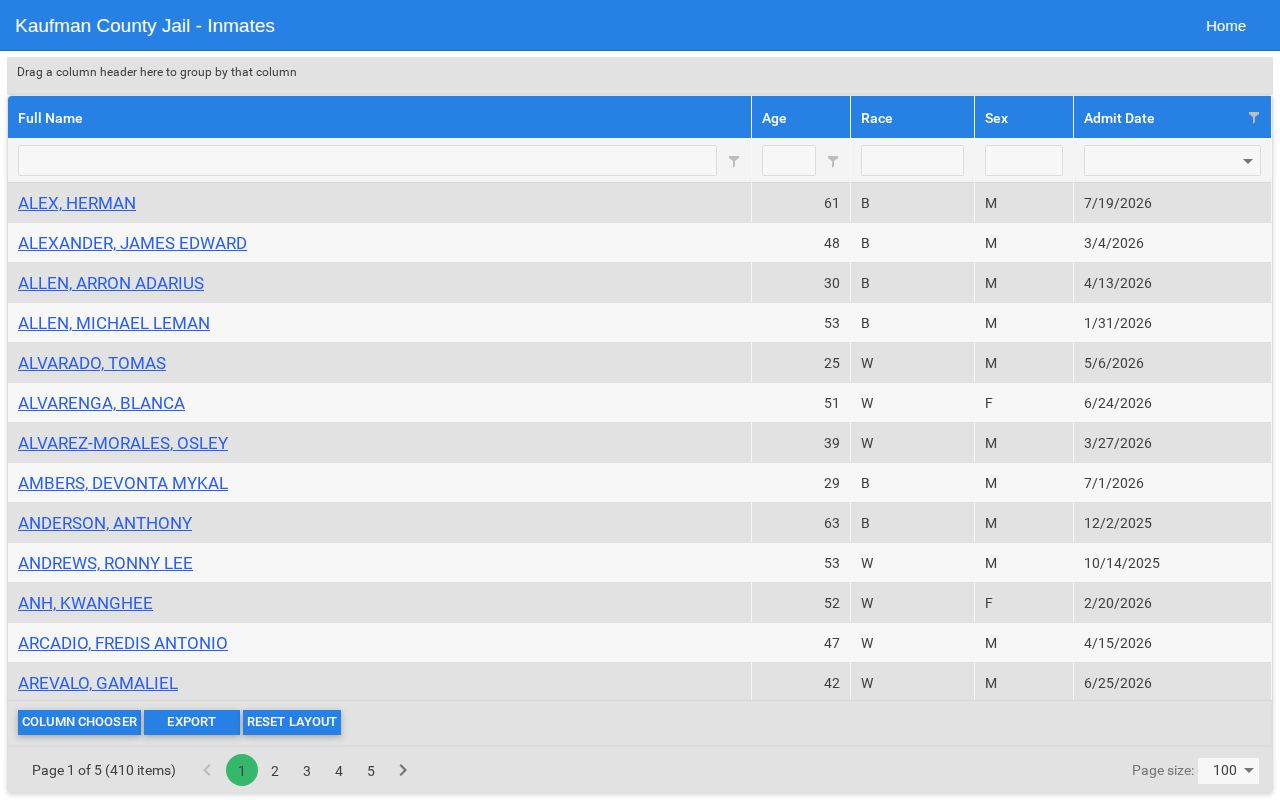
The sparse result makes the sheriff release sheet necessary for documentary confirmation.
Kaufman Release Reentry Coordination
Kaufman County's 2025 SIM report names TCOOMMI continuity of care, NTBHA screening and coordination, and APAA Reentry Peer Support. It blends current resources, workshop observations, and proposed improvements, so a named service is a navigation lead rather than proof of universal availability.
The report also conflicts on medication. An earlier gap section says seven days was typical and recommends 30, while a later resource map reports 30 days at release. Confirm current practice with the detention center and provider.
Release planning and release verification are related but different. A program referral may help explain where a person was directed after custody, yet it does not establish the legal release reason. The booking and release sheet, court order, and supervising-agency record remain the controlling trail. When continuity of care matters, obtain instructions directly from the jail and provider instead of relying on a planning document's snapshot.
Kaufman Release Alerts and Transfers
Texas moved county notification from VINE to Texas IVSS-Counties on September 1, 2025. Search one named record, verify identifiers and agency, choose available events, and complete current portal verification. Alerts can lag and are not certified release records.
Kaufman County's Victim Services page still documents its older VINE participation and bond-out notification. That local history does not make the legacy PIN instructions current. Follow the active IVSS portal's on-screen registration and confirmation steps. If a result disappears after release, ask the originating agency for the underlying event.
TDCJ has a separate post-conviction IVSS path. The BOP locator can retain a federal release date. ICE ODLS checks present immigration detention, not full history. USMS offers no broad public release archive. A county entry saying “released to immigration authorities” means Kaufman custody ended by transfer. It does not establish an immigration release or outcome.
Kaufman Release Search by Custody
Each system answers a different custody question. Match the tool to the episode.
| Situation | Best record | Limit |
|---|---|---|
| Still in county jail | Current roster | Not a release archive |
| Bonded or time served | Sheriff transaction and court order | TDCJ may have no record |
| TDCJ transfer | Sheriff destination and TDCJ | Roster removal is not freedom |
| State release | TDCJ status and dates | Projected is not actual |
| Federal release | BOP and federal docket | Other custody may remain |
| ICE transfer | Sheriff destination and ODLS | ODLS is present-custody focused |
Kaufman Release Court Records
The Odyssey Smart Search provides a durable case register after a jail listing disappears. Match the party and read bond, dismissal, judgment, sentence, probation, commitment, or discharge entries. The order explains the disposition; the sheriff gives the exact release time.
Class A and B misdemeanors and bond forfeitures belong with the County Clerk. Inspection is free, plain copies are $1 per page, certified copies add $5, and certification of facts is $5. Felony district records belong with the District Clerk. Juvenile files are confidential.
Kaufman Release Document Trail
Kaufman's Justice Center sits beside the jail, and sheriff, court, clerk, and pretrial offices cluster along 1900 to 1906 E US-175. The in-person trail is compact, but the custodians remain separate.
The sheriff supplies physical release data. The clerk and court supply disposition. Pretrial staff address monitored bond release. Keep those roles distinct.
Start with the document that answers the immediate question. For a door-out time or receiving authority, use the sheriff. For a judgment or dismissal, use the proper clerk. For monitored bond release, use the court order and pretrial office. Carry the same case and booking identifiers between offices so their records can be reconciled.
Kaufman County Release Facilities
The Kaufman County Detention Center is the main adult jail. Its releases can mean community return or transfer. The sheriff's release sheet and court record are the chief confirmation sources. No official source promises a fixed walk-out hour, public exit door, family waiting area, weekend routine, or property procedure. Operational questions belong with Jail/Inmate Records.
Forney Police Department Holding Cells provide short-term municipal holding. Forney's official report describes a maximum 72-hour detention, which is unrelated to the sheriff's three-day released search. Ask whether police released the person locally or booked the person into Kaufman County Detention Center. A transfer requires records from both agencies.
The Kaufman County Juvenile Detention Center belongs to the confidential juvenile court and probation system. Authorized parents, guardians, youths, attorneys, or other entitled people must work through those offices. Placement or transfer is not necessarily community release. No adult-style public youth list, name search, or photograph feed is appropriate.
Public Record Search
Sponsored Results